Product lead
BeYou
Product lead · Creative Human Evolution (CHE) · 2025 — 2026
CHE's flagship work was high-touch and bespoke. BeYou was my bet that the same insight could be productized into a self-serve app. I scoped the MVP, made the build-vs-defer calls, designed an AI architecture where one profile personalizes everything downstream, and built the whole thing solo in a two-week sprint.
0→1 · Product strategy · AI architecture · Subscription · Solo build
Context
CHE's flagship work was high-touch and bespoke: real insight, but delivered through human-intensive engagements that didn't scale. BeYou was my answer to a different question — what does that same value look like when it's productized? Something self-serve, recurring, and personal, that doesn't need a person in the loop every time.
The raw material was already there: a Value Signature Lab that profiles who you are, Hamper activities for building skills, Voyage content for daily growth. They just lived as separate, human-delivered pieces. BeYou's bet was that pulling them into one app — and letting them share data — would make the whole more powerful than the sum of its parts.
My role
Product lead, and in practice the only person on it. The original spark came from the COO, who handed me full creative latitude and an ambitious wishlist; my job was to turn that into something that could actually ship in the time we had. So I owned it end to end: scoping the MVP, choosing the stack, designing the AI architecture, building the front end and backend, and handing it off clean.
The judgment calls were the real work. I defined a tight MVP spine and was deliberate about what not to build. The point wasn't to ship everything — it was to prove the concept.
Approach
Initially, BeYou was a two-week sprint, so every decision was a bet on time-to-impact. I'd rather have the whole thing working roughly than one corner of it working perfectly.
- Build the spine first, defer everything else. I scoped the MVP down to a single path — Value Signature discovery → skill rating and alignment insights → career suggestions — because the prompting infrastructure mostly existed already. Everything non-essential I marked as a "hook point" and built only as far as time allowed.
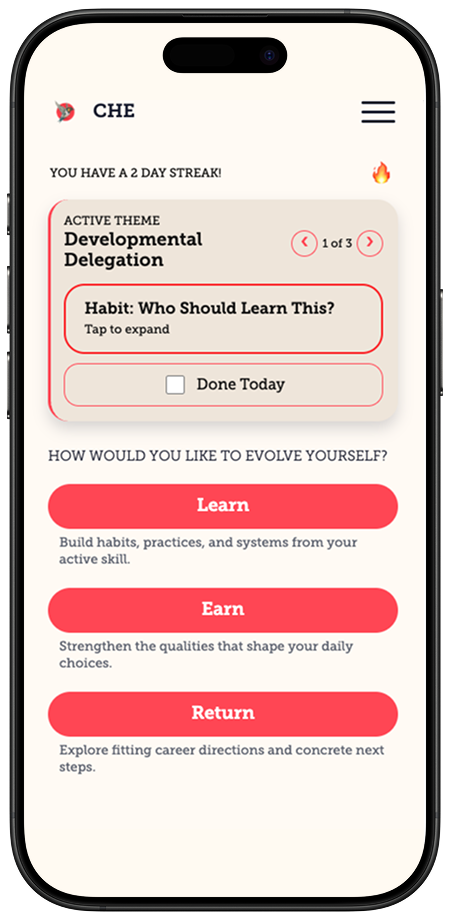
- Make one profile do the personalization. The Value Signature, generated once from twelve introspection questions, became a shared data layer that every other subflow reads from. That's the whole trick: editing your Value Signature has site-wide consequences, because Learn and Return are both built on it. One profile, generated once, makes each delivery feel personal without anyone delivering it by hand.
- Front end in one pass, then the hard part. I learned from past builds to get the entire front end done in one go — Figma mockups into AI, clean up the HTML — so I could focus on the backend. The architecture was honest about its limits too: to avoid the cost of background workers, AI generation only runs on the loading screen, a tradeoff I documented with two clear paths out.
Outcomes
A functional proof of concept, live behind a login and running end-to-end across all six subflows. It works as scoped; the gaps are documented and deliberate. No public launch or usage metrics yet — this was built to prove the concept, and it did.
Reflection
Pitching and scoping a product inside a company is its own design problem. The proposal has to make the smallest version feel inevitable, and writing the MVP as a series of explicit "not yet" decisions was what kept it shippable — every cut was a bet that I could prove the idea without that piece.
The thing I'd carry forward is how much the architecture decision early on paid off later. Making the Value Signature a shared data layer, instead of bolting personalization onto each feature separately, is what made the whole app cohere — and it's the part that would actually scale into a real product. Get the foundation right and everything downstream gets easier; get it wrong and you're patching forever.