AI Product
Value Signature Lab
Product owner & AI architect · Creative Human Evolution (CHE) · 2024 — 2026
CHE's flagship AI product — an executive-development tool used by Sky, the Jamie Oliver Group, Omnicom, and Rutland Holdings. I owned the product end-to-end and architected its AI pipeline.
LLM pipelines · Evaluation · UX · Product ownership
Context
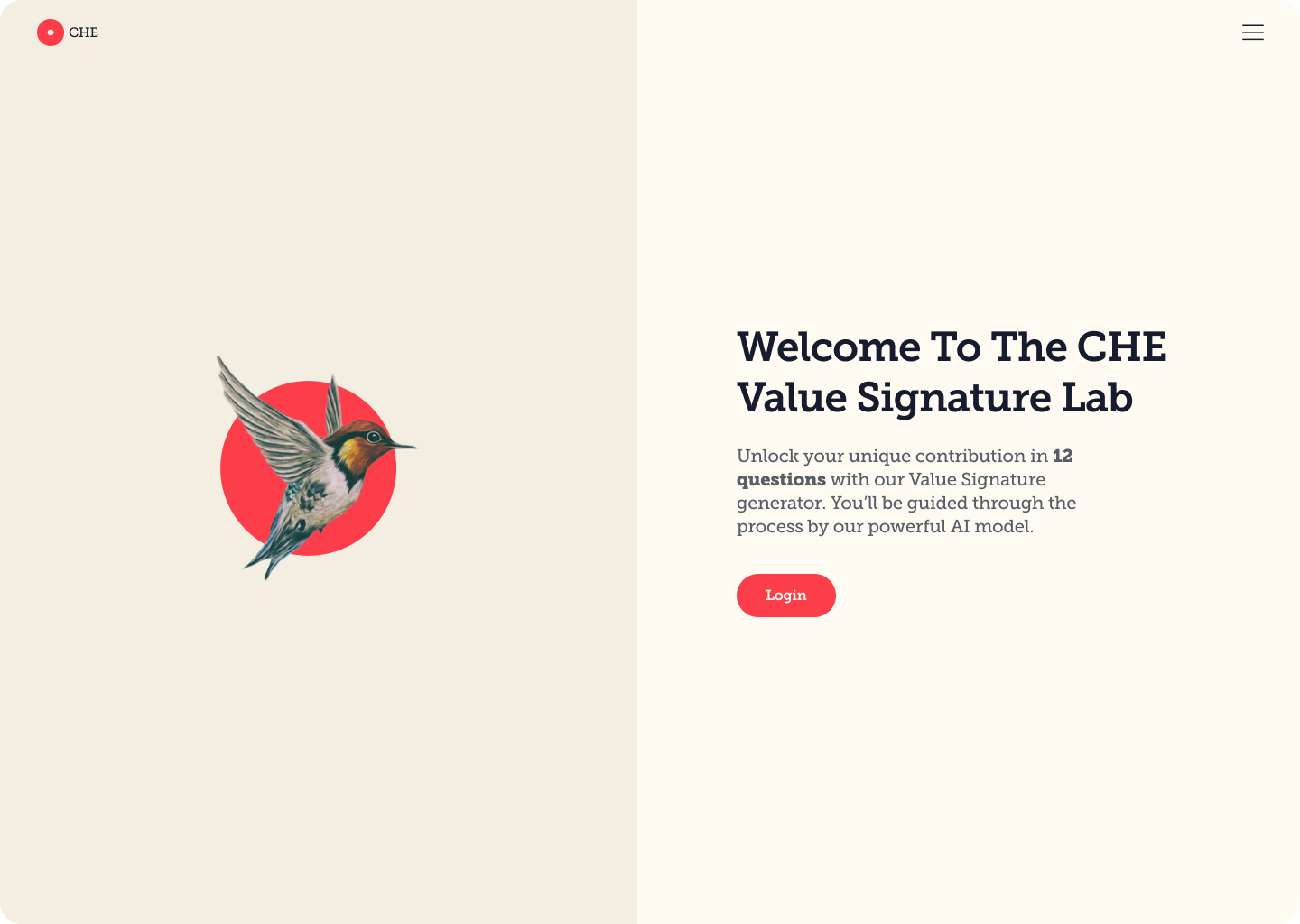
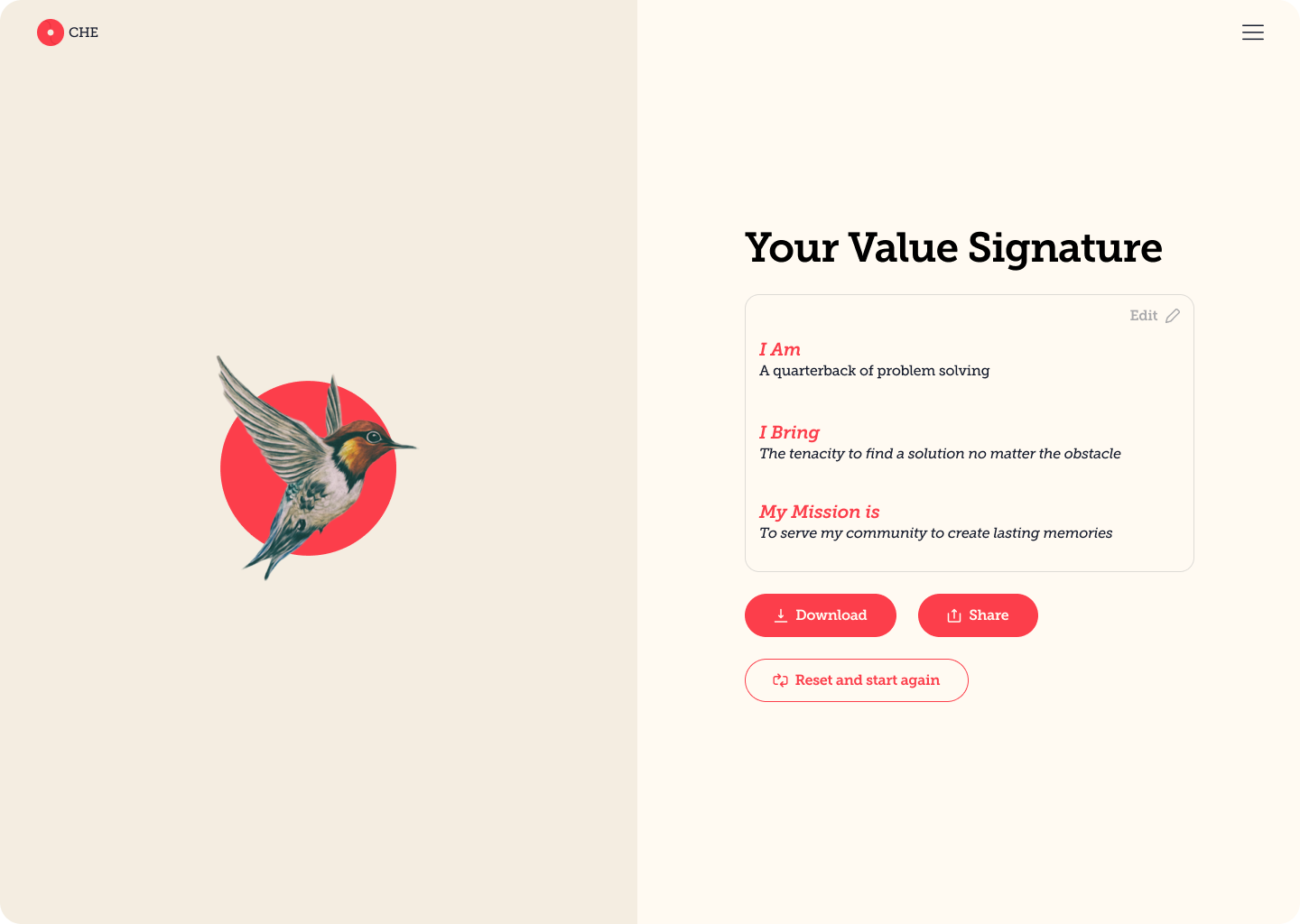
CHE builds personalized executive-development products, and the Value Signature is its centerpiece — a short, personal articulation of the distinct value someone brings, framed as an I Am / I Bring / My Mission statement. Until the Lab, each one was produced by hand, in a one-on-one interview with a practitioner. The Value Signature Lab was the company's bet on doing that at scale with AI — taking a high-touch coaching session and turning it into something a client could work through on their own, in twelve questions.
The challenge was the quality bar. I took it on at the idea stage and built the first working version — but getting a model to produce a Value Signature was never the hard part; producing a reliably good one was. The early output was inconsistent, hard to evaluate, and impossible to defend in an enterprise sales conversation. As the sole product hire, I owned the problem of making it both good and provably good.
My role
Product owner and AI architect. As the sole product hire, I owned the Lab end-to-end — I architected the AI pipeline and the evaluation system, designed the UX, and set the quality bar and the roadmap, working directly with the COO and the founder on direction. I built the prototype myself, gathered internal and external feedback to refine it, then handed it off to a developer to build into the production app.
I also owned the ongoing relationship with the enterprise clients who used it, which kept the quality bar honest: they were the ones who had to trust the output enough to put it in front of their own people.
Approach
-
I designed the system before writing a single prompt. I mapped the workflow, the inputs, and — critically — where each output would be judged, so prompting only began once I knew the target and how I'd iterate toward it.
-
I built the evaluation scaffolding first, then prompted into it. Every step got a unit test, a success criterion, and a way to compare iterations — scored on two lenses, execution quality versus design quality, so I could tell whether the AI had slipped or I'd designed the wrong flow.
-
The Value Signature was my single source of truth. I treated it as the irreducible anchor and validated it by stripping back to the minimum that still worked. The front of the chain mattered most: the smallest change upstream cascaded hard downstream.
-
I started simple and leaned on subtraction. I'd begin with the most basic prompt and add complexity only when it earned its place — more structure often made outputs worse, and a stripped-back prompt would routinely rival an elaborate chain. Positive, specific instructions beat telling the model what to avoid, and I kept applying the "intern test": could an average person do this with exactly the input I gave?
-
I optimized for iteration speed — and against fooling myself. I tuned my workflow around fast edit-test-evaluate loops to run as many tests as possible, while staying wary of overfitting to specific examples or model quirks, and of dev-production skew between what I tested on and what the system saw live.
-
I matched the approach to the model and the medium. XML structure for Claude, control parameters tuned per task rather than blanket, reasoners reserved for genuinely complex steps, and a constant eye on how front-end state got serialized into the chain's context.
-
I treated the Lab as something to discover, then version and improve. Rather than spec it all up front, I went looking for the true core and built up slowly. Once it worked end to end, that was V1 — logged, versioned, and the baseline for the next round. Discovery first, then disciplined iteration, with every failed run treated as information.
Outcomes
The Lab is now in active use by Sky, the Jamie Oliver Group, Omnicom, and Rutland Holdings, and the evaluation framework became the backbone of how we talk about quality with prospects.
Reflection
The biggest lever was making quality measurable. Once I could score an output cheaply and trust the score, everything downstream got faster — I could try something, check it against the number, and keep what actually worked.
Two things surprised me. Less usually won: I kept expecting a harder problem to need a more elaborate solution, and a stripped-back prompt kept matching the elaborate chain, with most of the real work living in the scaffolding around the prompts rather than the prompts themselves. And being able to prove the quality turned out to matter as much as the quality itself — the evaluation framework I built to iterate is what let enterprise clients trust the output, and it carried a craft that used to live in a one-on-one interview into something I could stand behind with a number.